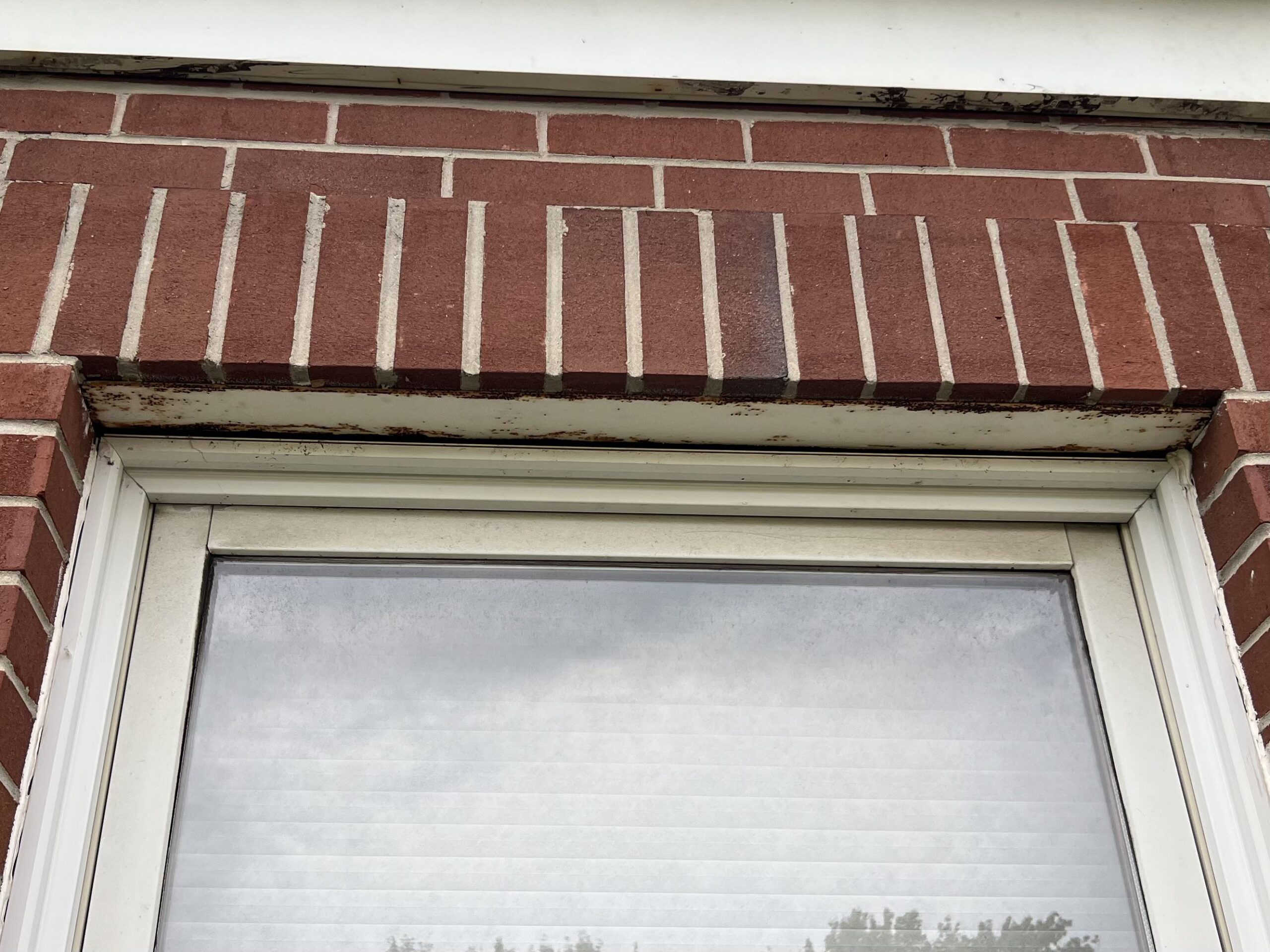
Look up at the brick above a window or garage door on an older home and you may notice a thin, horizontal line of rust, a slight sag in the brick course, or a crack that runs diagonally from the corner of the opening. These are classic signs of a failing lintel. Lintels are the steel angles or beams that carry the weight of the brick above every window, door, and garage opening, and when they corrode, the damage spreads outward into the surrounding wall in ways that surprise most homeowners.
This guide explains how lintels work, why they rust, how to recognize the warning signs early, and what repair typically involves.
What a Lintel Does
Brick is strong when it is stacked and compressed, but it cannot span an open gap on its own. Above every opening, a lintel bridges that gap and transfers the weight of the wall above into the masonry on either side. Most brick homes built from the 1950s onward use a galvanized or painted steel angle for this job, often resting on a small ledge of brick at each end. Older homes may use stone, brick arches, or reinforced concrete instead.
Because the lintel sits at the face of the wall and is partly exposed to moisture, it is one of the first structural components to show age.
Why Steel Lintels Rust
Steel does not need much encouragement to corrode. A lintel that is occasionally damp, in an environment with oxygen and the salts found in mortar and road spray, will rust steadily. A few conditions speed it up:
- Missing or damaged flashing. Flashing is meant to catch water running down inside the wall and direct it out through weep holes. When it is absent, torn, or poorly installed, water pools on the steel.
- Cracked mortar joints above the opening. Open joints let rain soak the brick and run directly onto the angle.
- Worn protective coating. Paint and galvanizing wear thin over several decades, particularly on lintels installed in lower-budget construction.
- Blocked weep holes. If water cannot exit above the lintel, it stays in contact with the metal.
- Freeze-thaw cycles. Southern Ontario winters repeatedly push moisture in and out of small gaps, which wears protective layers faster.
Why Rust Cracks Brick
Rust takes up considerably more volume than the steel it replaces, often several times as much. As corrosion builds up in the confined space between the lintel and the brick above it, it pushes outward and upward. This process, sometimes called rust jacking, lifts the brick course resting on the lintel and opens horizontal joints. Over time it also creates stair-step cracks rising from the ends of the lintel and can push the brick faces forward at the corners.
The result is both a structural and a moisture problem. As the cracks widen, more water reaches the steel, which accelerates the corrosion cycle. A small amount of staining can therefore turn into a significant repair within a handful of seasons if nothing interrupts it.
Warning Signs to Watch For
- Rust stains or flakes at the base of the brick directly above a window or garage door
- Horizontal cracks running along the mortar joint just above the lintel
- Stair-step cracks angling up from the corners of the opening
- A visible sag or dip in the brick courses over the opening
- Bulging or outward-leaning brick near the ends of the lintel
- Windows or doors that stick or no longer sit square in their frames
- Interior cracking in drywall or plaster at the corners of the window
Not every crack at a window corner is a lintel problem. Hairline cracks that look old and have not changed in several seasons are often caused by minor settlement or thermal movement. Cracks that widen, show rust, or appear alongside a sagging brick course deserve a professional look.
How Lintel Repair Works
The right repair depends on how far the corrosion has advanced.
Early Stage: Cleaning and Protecting
If the steel still has most of its thickness, a mason may be able to open the joints above the lintel, wire-brush the rust, apply a rust-inhibiting coating, repoint the area, and install flashing and weep holes where they were missing. This approach is relatively contained and can stop the cycle before it spreads.
Advanced Stage: Lintel Replacement
When the steel has lost significant section, flaked heavily, or lifted the brick, replacement is the safer option. The brick above is temporarily supported, the old lintel is removed, a new galvanized or stainless steel lintel is installed with proper bearing at each end, and flashing is added. Damaged brick and mortar around the opening is then rebuilt. This is skilled work, since the wall above must be supported safely throughout, and it is not a task for casual DIY.
Where the surrounding brick has also cracked or shifted, the repair often overlaps with broader brick repair so that the opening is rebuilt as a sound, weatherproof unit instead of a patched one.
Why Doing It Right Matters
A cosmetic fix, such as filling cracks with caulk or painting over the rust, will not stop the corrosion. The steel keeps expanding underneath, and the problem returns within a season or two, often larger than before. The long-term fix addresses three things together: the corroded steel, the missing water management (flashing and weep holes), and the damaged masonry around it. A thorough brick restoration approach considers all three instead of treating only what is visible.
Timing and Seasonal Considerations
Lintel work involves new mortar, which needs temperatures above roughly 5°C to cure properly. In Ontario, that makes late April through mid-October the practical window. Spring is a good moment for an inspection, because winter will have exposed whichever openings are letting water in. Homeowners in eastern communities, including those looking for Whitby masonry work, often book assessments in March or April to secure a spot before the busy summer months.
- How will the wall above the opening be supported while the lintel is replaced?
- What material is the new lintel, and is it galvanized or stainless?
- Will flashing and weep holes be added or corrected as part of the job?
- How will the surrounding brick and mortar be matched and repaired?
- Are other openings on the house at similar risk?
FAQ
How long does a steel lintel last?
It varies widely. A well-protected galvanized lintel with good flashing can last many decades, while an unprotected one in a damp location may show serious corrosion in 30 to 40 years.
Is a rusty lintel an emergency?
Usually not an emergency, but it should not be ignored. Active cracking, a visible sag, or bulging brick suggests the lintel is no longer carrying load properly and should be assessed promptly.
Can I just paint over the rust?
Painting can slow surface rust on exposed steel, but it does not fix the water source or the rust already built up behind the brick. It is a short-term measure at best.
Does home insurance cover lintel repair?
Typically not. Gradual corrosion is generally treated as wear and tear or deferred maintenance, so the cost usually falls to the homeowner.